
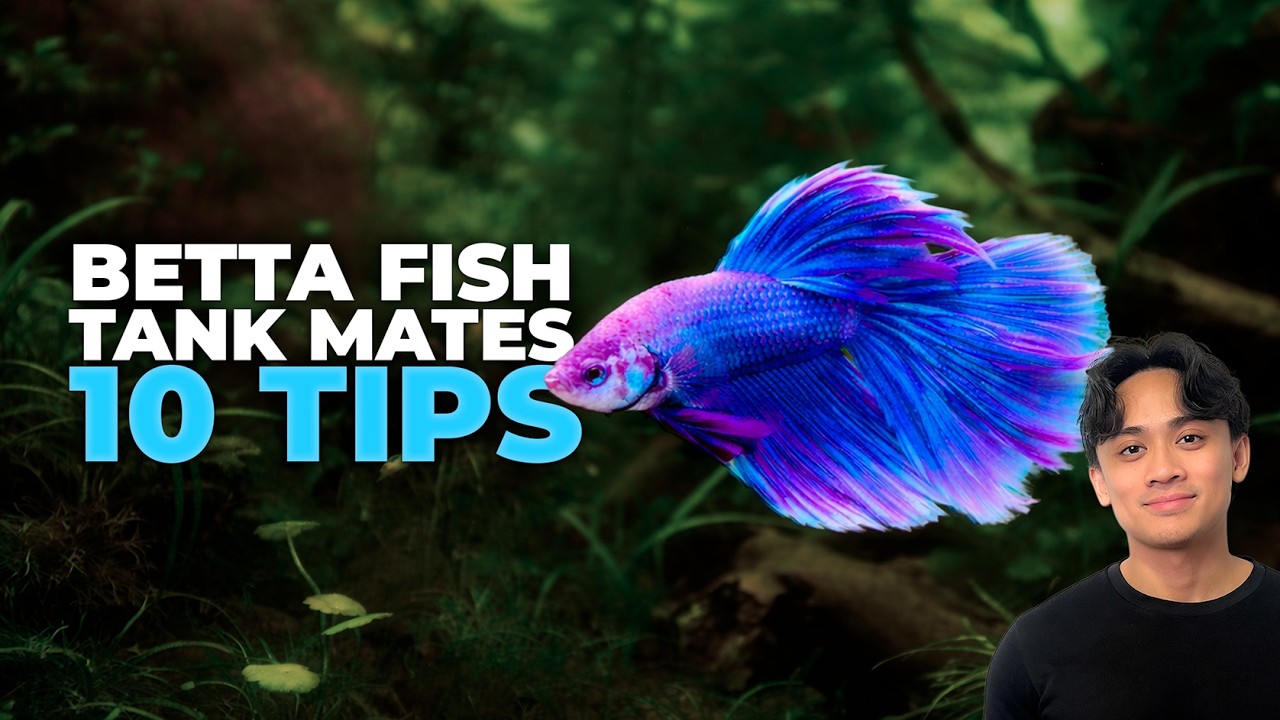


Betta Fish Tank Mates: What Fish Can Live With Bettas (And What Usually Fails)
Jan 28
6 min read
Can Bettas Live With Other Fish?

“What compatible tank mates can I keep with my betta?”
“What works?”
“What doesn’t?”
These are some of the most common questions in betta fish keeping, and they are rarely answered with the necessary context.
Most try to solve this by giving a short list of “safe” tank mates. The problem is that betta compatibility does not work that way. Whether a betta can live with other fish depends far more on behavior, environment, and stress management than on species alone.
This guide explains the ten tips that actually determine betta tank mate success, followed by realistic recommendations based on tank size.
Why Betta Fish Tank Mate Compatibility Is So Unpredictable
Betta fish are territorial by nature. In the wild, they live in shallow, slow-moving water with limited competition and clearly defined personal space.
In an aquarium, adding tank mates introduces:
Constant visual exposure
Competition for food
Reduced personal territory
Because of this, betta compatibility is conditional, not automatic. Some setups work well. Others fail despite good intentions. Understanding why failures happen is more valuable than memorizing a list of fish.
If betta tank mate compatibility were as simple as choosing the right species, the advice online would be consistent. It is not. Some people follow the same recommendations and see years of success. Others use the exact same tank mates and run into problems almost immediately.
That difference rarely comes down to the fish being added.
It comes down to the betta already in the tank.
Tip 1: Betta Personality Overrides Everything

No two bettas behave the same.
Some are calm and curious. Some are aggressive for life. Some change behavior depending on maturity, environment, or stress.
There is no reliable way to predict a betta’s temperament ahead of time. This is critical to understand because every rule that follows becomes irrelevant if your betta’s personality is not compatible with tank mates.
You can do everything correctly and still fail if your betta simply is not wired for it.
The only way to learn where your betta falls is careful observation and a willingness to intervene quickly.
Tip 2: Choose Tank Mates That Use Different Space and Time
Bettas primarily occupy the top and upper mid portion of the water column, and they are most active during the day.
One of the most effective ways to reduce conflict is to choose tank mates that do not compete with the betta in either space or timing.
Fish that stay near the bottom, move through different zones, or are active during different hours tend to be ignored more often. This reduces direct interaction, visual stress, and territorial pressure.
This is why bottom dwellers, algae eaters, and nocturnal species tend to work more consistently than fish that share the same space and schedule as a betta.
Examples include corydoras (Corydoras spp.) and otocinclus (Otocinclus spp.), which remain near the bottom of the tank. Kuhli loaches (Pangio spp.) are another strong option, as they are primarily nocturnal and most active when bettas are resting. Together, these species reduce direct overlap in both space and activity.
This approach does not guarantee success, but it meaningfully improves your odds.
Tip 3: The Order of Adding Fish Matters
Territory plays a major role in betta aggression.
If possible, add tank mates first and introduce the betta last. If your betta is already established, the territory can be reset by:
Temporarily removing the betta
Rearranging plants, decor, and hardscape
Adding the tank mates
Reintroducing the betta
This helps dissolve the betta’s sense of ownership over the space and reduces the likelihood of immediate aggression.
Tip 4: If It Looks Like a Betta, Expect Aggression
Bettas respond strongly to visual cues, not just behavior.
Bright colors, iridescence, and flowing fins can resemble another male betta, even if the fish itself is peaceful. This commonly triggers flaring, chasing, or attacks.
This is why fancy male guppies (Poecilia reticulata), male endlers (Poecilia wingei), and gouramis (family Osphronemidae) are unreliable tank mates.
Sometimes they work. Often they do not. If a fish looks like a rival, aggression should be expected.
Tip 5: Avoid Keeping Bettas With Other Bettas
Mixing bettas carries high risk with little reward.

Male bettas are never compatible with other males
Small female groupings are unstable long term
Even female sororities that appear successful can collapse suddenly
Male and female pairings are possible but should be left to experienced breeders.
For most keepers, mixing bettas introduces chronic stress without meaningful benefit.
Tip 6: Avoid Aggressive, Nippy, or Hyperactive Fish
Bettas tolerate calm tank mates. They do not tolerate chaos.
Fish such as tiger barbs (Puntigrus tetrazona), freshwater puffers (Tetraodon spp., Carinotetraodon spp.), and aggressive gouramis (Osphronemidae) are poor choices.
Neon tetras (Paracheirodon innesi) are a common wildcard. Some setups succeed, while others fail due to persistent fin nipping. They are popular, but not dependable.
Tip 7: Tank Size and Water Conditions Set the Ceiling
Small tanks force constant interaction. A five-gallon tank does not provide enough space for fish tank mates and should not be considered for community setups in most cases.
In practical terms:
Fifteen gallons is where compatibility becomes realistic
Larger tanks give fish room to avoid one another
Water conditions must also align. Bettas require warm, low-flow water. Cold-water or high-flow species such as goldfish (Carassius auratus) or White Cloud Mountain Minnows (Tanichthys albonubes) are incompatible regardless of temperament.
Tip 8: Community Tanks Complicate Feeding
In a community tank, feeding becomes harder to control.
Bettas often eat their own food and then steal from other fish. This can lead to bloating in the betta and malnutrition in slower tank mates. It can also result in feeding the betta foods that do not align with its dietary needs.
Community tanks often require deliberate feeding strategies and closer monitoring than single-species setups.
Tip 9: Early Success Does Not Mean Long-Term Success
Many betta community tanks fail weeks or months after appearing peaceful.
As bettas mature, territorial behavior can increase. Compatibility is not fixed. A tank that works today may not work indefinitely, which is why ongoing observation matters.
Tip 10: Always Be Ready to Separate Fish

This is non-negotiable.
Aggression can escalate quickly, and waiting to “see if it works out” often ends badly. A cycled backup tank should always be available so either the betta or the tank mate can be separated immediately.
Out-of-sight separation matters. Continued visual contact can maintain stress even after physical separation.
Betta Fish Tank Mate Recommendations by Tank Size
These are not guarantees. They are conservative options that follow the rules above.
Tank Mate Type | Recommended Tank Size | Compatibility Level | Key Notes |
Ramshorn Snails | 5+ gallons | High | Hardy, ignored by most bettas |
Bladder / Pond Snails | 5+ gallons | High | Small, low interaction |
Trumpet Snails | 5+ gallons | High | Burrow, minimal visibility |
Assassin Snails | 5+ gallons | High | Usually ignored |
Nerite Snails | 10+ gallons | Medium–High | Requires a well-seasoned tank with established algae |
Mystery Snails | 10+ gallons | Medium | Antennae may be bitten |
Cherry Shrimp | 10+ gallons | High | Adults may survive, babies often eaten |
Amano Shrimp | 10+ gallons | High | Larger size improves survival |
Ghost Shrimp | 10+ gallons | High | Cheap, often preyed on |
Pygmy Corydoras | 15+ gallons | Medium–High | Bottom dwellers, calm |
Otocinclus | 20+ gallons | Medium–High | Peaceful, bottom-oriented |
Kuhli Loaches | 20+ gallons | Medium–High | Nocturnal, ignored by bettas |
Chili Rasboras | 15+ gallons | Medium | Very small, low visual threat |
Harlequin Rasboras | 20+ gallons | Medium | Watch for chasing |
Rummynose Tetras | 20+ gallons | Medium | Schooling reduces issues |
Cardinal Tetras | 20+ gallons | Medium | Monitor for fin nipping |
Green Neon Tetras | 20+ gallons | Medium | Smaller than standard neons |
Neon Tetras | 20+ gallons | Medium | Common fin nippers |
Fancy Male Guppies | Any | Low | Resemble rival males |
Male Endlers | Any | Low | Color triggers aggression |
Tiger Barbs | Any | Very Low | Aggressive fin nippers |
Puffers | Any | Very Low | Aggressive and territorial |
Goldfish | Any | Not Compatible | Cold water, high bioload |
White Cloud Mountain Minnows | Any | Not Compatible | Cool, fast-flowing water |
Final Takeaway
Most people come into this question looking for permission. They want to know which fish they can add without things going wrong.
The reality is that betta tank mates are not about finding the right species. They are about accepting the responsibility of managing stress, space, and behavior over time.A betta that lives alone in a stable, predictable environment is not missing out. It is often healthier, calmer, and more resilient than one placed in a community setup that barely works.
If you choose to add tank mates, do it deliberately. Choose conservatively. Observe constantly. Always have a plan to separate fish the moment conditions change. There is no failure in deciding not to run a community tank. In many cases, that choice reflects the highest level of care.
Comments